How to Build an RFP Response Template
An RFP response template guarantees nothing required gets left out and removes the blank-page problem so your time goes into tailoring rather than rebuilding. Here's how to build one section by section, how to design it for the way evaluators actually read, and how to keep improving it after every bid.
To build an RFP response template, create a reusable document containing six standard sections - title page, cover letter, executive summary, scope of work, pricing and attachments - then fill each with boilerplate you can customize per bid. A good template does two jobs at once: it guarantees nothing required gets left out, and it removes the blank-page problem so your time goes into tailoring rather than reconstructing. Here's how to build one, section by section, and how to design it so evaluators actually enjoy reading it.
What Are the Components of an RFP Response Template?
| Section | Purpose | Reusable or per-bid? |
|---|---|---|
| Title page | Formally identifies your bid and the solicitation it answers | Reusable layout, per-bid details |
| Cover letter | Makes a first impression and states why you're qualified | Reusable structure, per-bid opening |
| Executive summary | Introduces your company, key staff, org chart and references | Largely reusable |
| Scope of work | Proves you understand the problem and can deliver the solution | Per-bid |
| Pricing | Presents costs in the format the buyer requested | Per-bid |
| Attachments / appendix | Holds certifications, resumes and supporting documentation | Mostly reusable |
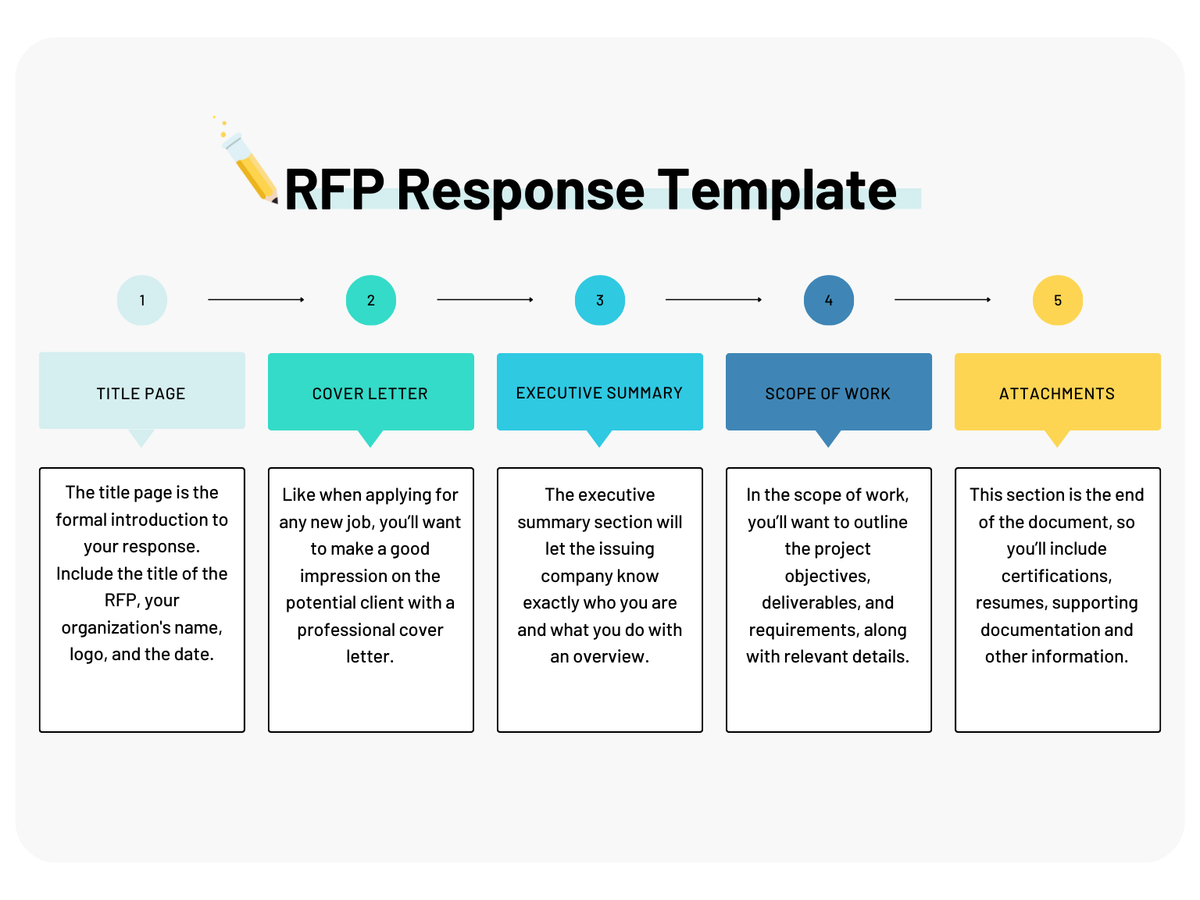
Every RFP has its own recipe, but nearly all of them call for these same ingredients. If you want a closer look at the content that belongs inside each section - company story, personnel, references, response database - start with our companion guide on what goes into an RFP response template. This guide focuses on building and designing the template itself.
What Belongs on the Title Page?
Keep it spare. Include the issuing organization's name, the RFP reference number and title, your business name and logo, and your submission date. Align everything cleanly and use a font size that's easy to read at a glance. What doesn't belong: marketing taglines or product claims. The title page exists so a reviewer holding a stack of bids can instantly identify which solicitation yours answers and who submitted it - nothing more.
Should You Include a Cover Letter Even If It's Not Required?
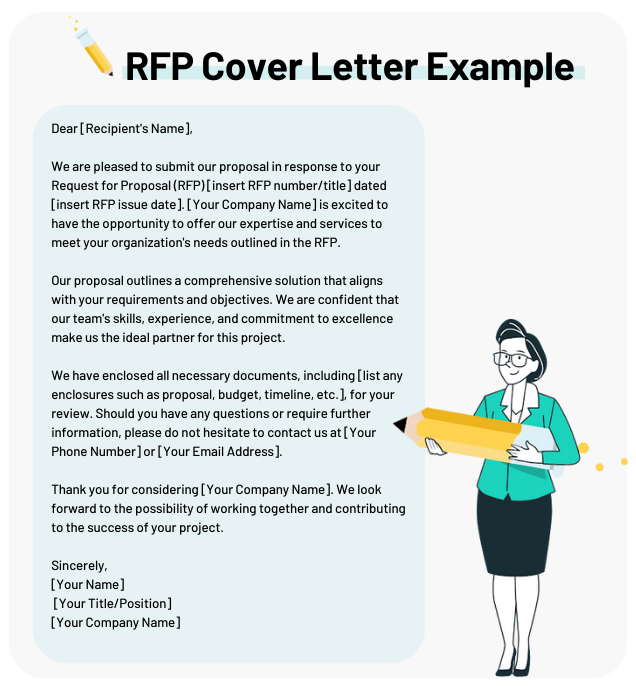
Yes - always. Many RFPs don't ask for a cover letter or letter of transmittal, which is exactly why including one helps you stand out. It's often the only place in the entire response where your company's personality is allowed to show, and the only chance to say why this particular project resonates with you. Keep it to three moves: thank the issuer for the opportunity, state briefly who you are, and summarize why you're qualified to meet the requirements. Our guide to what to include in an RFP cover letter goes deeper.
What Goes in the Executive Summary Section?
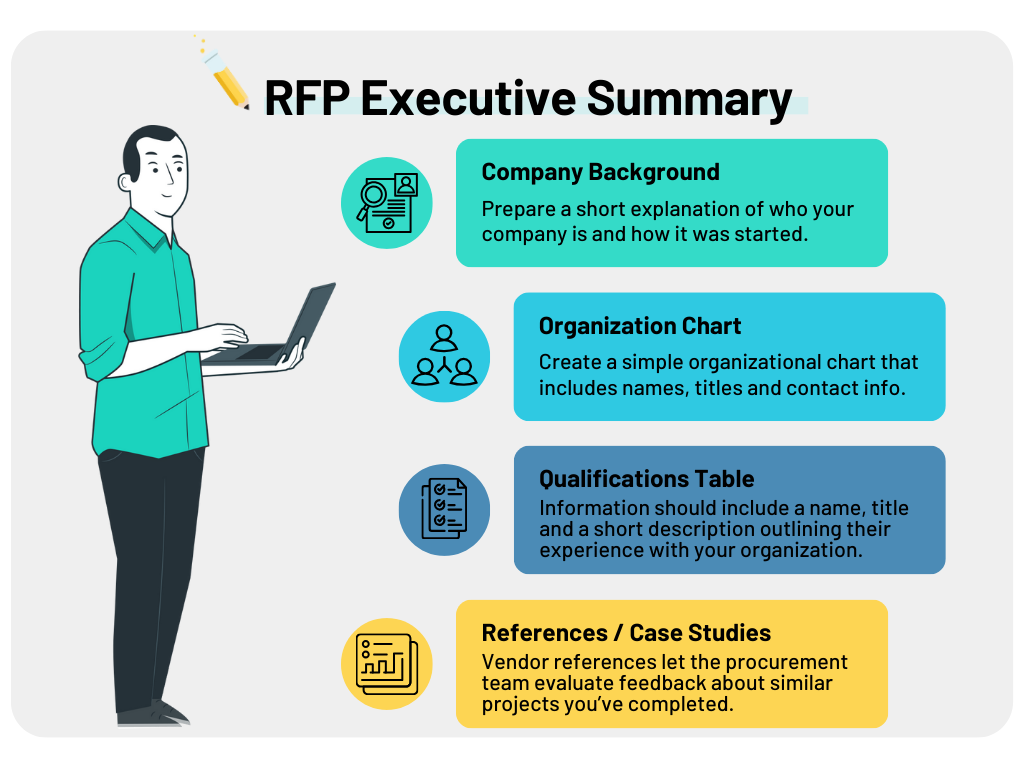
This is your organizational introduction, and it's the most reusable part of the template. Build placeholders for four elements:
- Company background. A short account of who you are and how you started, including your mission or values. Tie it to the issuer - note where your work and theirs overlap.
- Organizational chart. Buyers want to know who will manage the project and whom to call with questions. Names, titles and contact information.
- Qualifications table. For each key staff member: name, title and a short description of their relevant experience. Emphasize work similar to the project at hand.
- References or case studies. References let the evaluation team hear how comparable projects went. No references yet? Write a case study of a completed project covering the scope and the outcome.
How Do You Structure the Scope of Work?
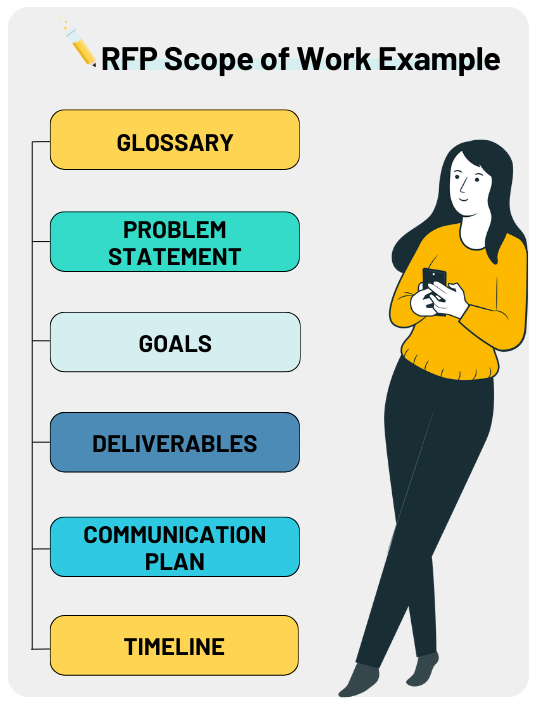
The Scope of Work (SOW) describes what the issuer wants to achieve and how you'll achieve it. It's the section that proves you read the solicitation carefully, and it establishes what ends up in the resulting contract. Structure it with six parts:
- Glossary. Define terms and acronyms you use. Clarifying company-specific language prevents confusion and explains what you do.
- Problem statement. Describe the problem to be solved and the current state of things. Demonstrate that you understand it before you propose fixing it.
- Goals. State the project's end goal in a few sentences. Answer plainly: what's the point of this RFP?
- Deliverables. Outline every deliverable and task in detail, ideally in a table, so both parties can see exactly who does what.
- Communication plan. Specify meetings, calls, status updates and reviews so the client knows how progress gets reported.
- Timeline. Lay out all project dates, deliverable due dates and communication milestones - again, a table reads far better than prose here.
The failure mode to avoid is vagueness. A specific, thought-through SOW signals that you evaluated the RFP in detail and are confident you can meet its needs. A generic one signals the opposite.
What Should the Attachments Section Hold?
Treat the appendix as your evidence locker: certifications, licenses, insurance documentation, staff resumes, financial statements, and any supporting material referenced in your answers. A useful rule of thumb is to include anything genuinely relevant even when the RFP doesn't require it - provided it strengthens your case rather than padding the page count. Keeping these documents current in your template means you're never scrambling for an expired certificate the day before a deadline.
Made for small businesses.Start searchingHow Do You Design a Template Evaluators Want to Read?
Imagine an evaluator working through a stack of plain black-and-white responses, then reaching one with strong content, considered typography, a restrained use of color and purposeful imagery. Design won't win a bid on its own, but it can be the final nudge that moves you to the top of the list - and a well-designed document signals that you invested real effort.
Design for how the document will actually be consumed. Evaluators scan for specific requirements under time pressure, so build your template with clear section headings that mirror the solicitation's own structure, generous white space, tables wherever data would otherwise become a paragraph, and consistent styling you never have to rebuild. Anticipating the evaluator's pain points is the whole exercise.
Can You Automate Your RFP Responses?
Partially - and the boundary matters. Automated proposal tools genuinely save time on assembly and content retrieval, but RFP language varies too much for software to reliably pick the correct pre-written answer. The workable approach is hybrid: let AI and automation handle retrieval, formatting and tracking, then have a person tailor every response through a real review. As we've argued before, RFP tools are only as good as the writer using them.
One thing worth automating without reservation: tracking. Keep metrics, KPIs and past-performance data current in a central place so every bid pulls from accurate numbers instead of last year's.
How Do You Keep Improving the Template After Each Bid?
Treat the template as a living asset. After every submission, fold the strongest new answers back into it and retire anything that's aged badly - this is how a template becomes a content portfolio rather than a static form. Audit periodically for stale language and buzzwords that have crept in, and refresh certifications and staff bios on a schedule.
If you win, one more step protects you: before work starts, secure written agreement on scope, reporting requirements and deliverables. Ambiguity you tolerate at kickoff becomes scope creep by month three. Designating an internal negotiation team - with a documented list of negotiation ranges and non-negotiables - keeps those conversations from being improvised.
Where Do You Find RFPs to Use Your Template On?
A template only pays off if you're bidding regularly. Our guide to finding new RFPs covers building a repeatable search across agency portals, eProcurement sites and aggregators - and Bid Banana, The Bid Lab's own searchable RFP database, pulls opportunities from across jurisdictions so you don't have to check each one.
Your Writing Deserves the Right Bid
Great proposal writing is wasted on a poor-fit solicitation. Narrow the field by keyword, agency and due date before you start drafting. Search open opportunities on Bid Banana.
Frequently asked questions
How do you build an RFP response template?▼
Create a reusable document with six standard sections - title page, cover letter, executive summary, scope of work, pricing and attachments - then populate each with boilerplate you customize per bid. Company background, org chart, key staff and references are largely reusable; scope of work and pricing are written fresh for every solicitation.
What are the components of an RFP response template?▼
A title page identifying the solicitation, a cover letter making your first impression, an executive summary covering company background and key staff, a scope of work proving you understand the problem, a pricing section in the buyer's requested format, and an attachments appendix holding certifications and resumes.
Should an RFP response include a cover letter if it isn't required?▼
Yes. Most RFPs don't require one, which is exactly why including it helps you stand out. The cover letter is often the only place your company's personality can show and the only chance to explain why this project resonates with you. Thank the issuer, introduce your company briefly, and summarize your qualifications.
What should an RFP scope of work include?▼
Six parts: a glossary defining your terms and acronyms, a problem statement showing you understand the current state, clearly stated goals, a detailed deliverables list (ideally a table), a communication plan covering meetings and status updates, and a timeline with all project and deliverable dates.
Can RFP response software replace writing each response yourself?▼
No - but it helps. Automation genuinely speeds content retrieval, formatting and tracking, yet RFP language varies too much for software to reliably select the right pre-written answer. The effective approach is hybrid: let tools handle assembly and data, then have a person tailor every response through a real review.